Monday, June 16, 2008

Week 8 - Context

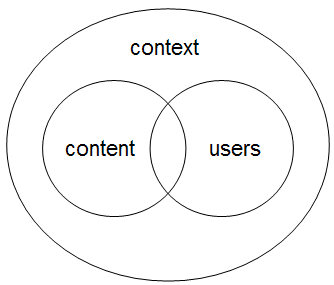
Context theory: is the theory of how environmental design and planning of new development should relate to its context. When decisions have been taken they are implemented by means of lands use zones, zoning plans and environmental assesments. A number of context theories set out principles for relationships new designs and the existing environment.

Context Definition: the parts of the environment (physical, environment, historical, etc.) that surround something such as a word, passage, or work of art and can throw light on its meaning

Context refers to a set of circumstances that surround a particular event or situation. This may take into account different aspects such as social, political or cultural influences.
Examples are:

Political Context: Reflects the environment in which something is produced indicating its purpose or agenda. Often political messages are intended to persuade one way or another. Knowing who created the message and what their relationship is to others reflects how you interpret that message.

Social Context: The environment of people that surrounds something's creation or intended audience social context reflects how the people around something use and interpret it. The social context influences how something is viewed.

In definition context refers to a set of circumstances that surround a particular event or situation, which takes into account different aspects such as social, political or cultural nfluences.

Political context reflects the environment in which something is produced indicating its purpose or agenda. Often political messages are intended to persuade one way or another. Knowing who created the message and what their relationship is to others reflects how you interpret that message.

Social context involves the environment of people that surrounds something’s creation or intended audience social context reflects how the people around something use and interpret it. In short, context is the environment in which something relevant exists or happens. The relevancy changes with time, as something could be relevant in the past but it may not be relevant in the future.

Specifically in regards to Architecture, an architect needs to understand the environment or context in which the project will be designed and built. If the idea is to design a project within certain parameters such as financial, cultural, and environmental then they have to design to fit this context. For example a building that may not fit the right context or may not be in the right environment would be a building that is made from completely different material to other buildings in the same area. Furthermore a religious or cultural building may not be in the right environment. This would lead to it being built in the wrong context.


http://en.wikipedia.org/wiki/Context

http://www.boxesandarrows.com/files/banda/competitive_analysis_understanding_the_market_context/withrow_1.gif

Week 7 - Hierarchy

Hierarchy is best described as an arrangement of objects, people, elements, values, grades, orders or classes in a ranked or graduated series. The word is derived from the Greek word hierarchia, hieros meaning sacred and arkho meaning to lead or rule. Best examples of this are in governments, workplaces and even in religion. [1]

Hierarchy is most important in the world of architecture, as it is needed when individuals are working in a group. It helps establish a ladder of authority, with each person in the group assigned a particular job, and a responsibility on that job which must be completed within the group. The importance of hierarchy is that it enables all the people in the group to work effectively, and to help direct each one in there given task. It particularly helps when a person has a problem, as that problem can easily be solved by following the ladder up, to the correct person to address the problem.

Many problems can arise from incorrect hierarchy, especially in group work. The main problem is when there isn’t a clear understanding of the hierarchy established when each member of the group doesn’t fully understand the importance of each person’s role within the group, so the main flow of work isn’t undertaken by each person.

In collaboration, each party accepts responsibility for its own inputs as well as for the equitable sharing of returns on outputs. Collaborative relationships are voluntary. They facilitate knowledge creation. Corporations, however, are typically based on hierarchical, non-voluntary relationships. Corporations are built to exploit knowledge and to appropriate a financial profit from it. Consequently, collaboration is difficult to combine with corporate hierarchy. Nevertheless, there is a growing list of examples illustrating successful co-existence of collaboration and hierarchy. [2]

Below is a simple visual to represent what many of us may be currently experiencing in the workplace. Most companies leverage the traditional reporting hierarchy which has worked for generations. But in addition to this, we are increasingly seeing smaller teams breaking out into streamlined work groups. These teams may be composed of individuals from different “tiers” in the traditional hierarchy representing a variety of disciplines. Some managers have advocated for more smaller, faster, leaner teams. Others advocate for more formality, structure and rigor. Some companies blend both equally. [3]


http://en.wikipedia.org/wiki/Hierarchy [1]

http://www.iou.uzh.ch/bwl/iou/lehrveranstaltungen/SS2004/Topics_and_Literature_Seminar_Collaboration_SS_2004.pdf [2]

http://darmano.typepad.com/logic_emotion/2006/07/human_hierarchy.html [3]

Sunday, June 15, 2008

Week 6 - Intent

To have intent is to have an aim or purpose to complete a set task. Whether that’s in the workplace, individual, or in a group, intent must be given at the start of any project to give all participants a clear goal. Each task must be explained in full to each person assigned to complete the task, with a full understanding of the aims and goals need to be achieved. Each goal must be an achievable one by each person, whether they are in the short term or long term and must be performed at the best of their ability.

The way the intention of a job is described to the people undertaking it is also very important, as the final goal and objective should never be lost. These can be outlined in many ways, either by reinforcing it through speech, written form and even visual. This can also include budgeting and set time frames. These must be continually reinforced during the work processes, to keep the workers motivated and concentrated on the final goal and the tasks ahead, as without intent there isn’t a goal that is achievable.

In our group project, the initial intent was given, so as to give each team member a certain task and goal. Each person was allocated a specific task, which had to be completed by a set time. We also had meetings to reinforce what the groups main goal was, and to reinforce what had to be done in the current step of the project in what timeframe so that everything can completed in the end.

Sunday, April 20, 2008

Week 5 - Knowledge

Organisations today are facing increased challenges, brought on by pressures of the workplace. In today's economy, knowledge sharing and collaboration are the survival skills of the 21st century [1]. Many organisations are now looking to knowledge management to address these challenges. Such initiatives are often started with the development of a knowledge management strategy [6].

Below is a detailed description of what is knowledge? What is knowledge collaboration? The Role identifications within knowledge management, Knowledge management systems and the benefits of knowledge management.

What is Knowledge?
We can define Knowledge as being "information combined with experience, context, Interpretation, and reflection. It is a high-value form of information that is ready to apply to decisions and actions." (T. Davenport et al., 1998) Knowledge itself comes in two forms:
Explicit knowledge – It is knowledge has been recorded and documented and can be shared with others
Tacit knowledge – Tacit knowledge refers to knowledge that is known, but has not been shared with others. Tacit knowledge is problematic in a support organization because if it is not shared with others, it cannot be leveraged to solve problems and is gone when the knowledge holder leaves the organization [5].

What is Knowledge Collaboration?
Knowledge collaboration for an Architectural Organization is the successful implementation of Knowledge-Centred Support. Evidence of good Knowledge Collaboration is seen when the successful implementation of Knowledge-Centred Support has been completed.

This, in turn, leads to:
• Improved speed of collaboration,
• Positive customer perception, the Architect knows what they are doing.
• Leveraging tacit knowledge and enabling authors to turn it into explicit knowledge
• Ownership and increased enthusiasm on the part of experts.[5]

Identify Roles in Knowledge Collaboration
Knowledge collaboration flows through a chain of people communicating from various perspectives. By identifying the key roles along this chain, the people who play those roles, and their perspectives, you can help to make this flow smoothly. Identifying the knowledge collaboration roles for each user plays within the organization will help to scope and plan the implementation. The key roles in the knowledge collaboration are:
• Owners
• Producers
• Consumers
• Problem Manager/Quality Analysts [5]

Knowledge Management System (KM System)
Is a system for managing knowledge in organizations, supporting creation, capture, storage and distribution of information.

The idea of a Knowledge Management system is to enable employees to have ready access to the organization's based documented of facts, sources of information, and solutions. For example an engineer could know the metallurgical composition of an alloy that reduces sound in gear systems. Sharing this information organization wide can lead to more effective engine design and it could also lead to ideas for new or improved equipment.

A Knowledge Management system could be any of the following:
Document based i.e. any technology that permits creation/management/sharing of formatted documents such as Lotus Notes, web, distributed databases etc.
Provide network maps of the organisation showing the flow of communication between entities and individuals. Increasingly social computing tools are being deployed to provide a more organic approach to creation of a Knowledge Management system.

The Benefits of Knowledge Management Systems
Some of the advantages claimed for Knowledge Management systems are:
Sharing of valuable organizational information.
Can avoid re-inventing the wheel, reducing redundant work.
May reduce training time for new employees
Retention of Intellectual Property after the employee leaves if such knowledge can be codified. [4]

Developing a knowledge management strategy provides a unique opportunity to gain a greater understanding of the way the organisation operates, and the challenges that confront it. By focusing on identifying staff needs and issues, activities and initiatives can be recommended with the confidence that these will have a clear and measurable impact upon the organisation. Taking this approach to the development of a KM strategy allows limited resources to be targeted to the key needs within the organisation, delivering the greatest business benefits while positioning the organisation for long-term growth and stability.

http://www.knexa.com/[1]
http://en.proverbia.net/citastema.asp?tematica=688[2]
http://en.wikipedia.org/wiki/Knowledge_management[3]
http://www.answers.com/topic/knowledge-management-system?cat=technology[4]
http://www.thinkhdi.com/hdi2006/files/StrategicAdvisoryBoardPaperKnowledgeCollaboration.pdf[5]
http://www.steptwo.com.au/papers/kmc_kmstrategy/index.html[6]
http://www.steptwo.com.au/papers/kmc_kmstrategy/index.html[7]

Week 4 - Records

The definition of record management is the practice of identifying, classifying, archiving, preserving, and destroying records. Records is also "information created, received, and maintained as evidence and information by an organisation or person, in pursuance of legal obligations or in the transaction of business"[1]

Record keeping is an important aspect of architecture, all records need to be keeping such as word documents, drawing files hard copy or electronic and let’s not forget meeting records which are the minutes of the project.

Keeping record of any information is imperitive in the running of any job. From anything to setting down in writing, images or even sound, for the sole purpose of preserving evidence. As history has shown us, many records of the past have been used to helps us learn about our history, and present, but also helps us in answering questions for the future. This can be shown in recording information at work, and especially when many people are working together on a project. In any group work, it is important to record any work that has been completed. This is most important as it helps the individuals see what has been completed, and what the progress of completion is, on each individual part. In the case of where the work has to be continued by another person, that person can just see what has been completed so far, and continue on without much interruption in the progress of the project. It also helps in the future when a simple job has to be completed, as it gives a approximate estimate as to the duration of each task, and any problems that may arise in each step, and more importantly the solutions. Also, it can assist in problem solving when a mistake is picked up further down the work progress. It can be traced back to the person who worked on the project at the time of the mistake, so he/ she can be brought up to fix the problem.

In our group project records are important as it help us with the process of forming our presentations. We have found that having one person (being the group leader) it helps keep the organization process under control.

http://en.wikipedia.org/wiki/Records_management%5b1]

Saturday, April 19, 2008

Week 3 – Discipline

The building and construction industry is a fast growing industry with an expanding list of professionals such as architect, engineers, landscape architects, interior decorators, surveyors and let’s not forget local government authorities.

Once a client approaches the first consultant being the Architect who in turn is the client’s representative the design process begins and the architect leads the project to the final stage of construction.

Each Discipline has their own skills, rules and responsibilities to the client to finalise their requirements and to complete this project.

In our project we as a team have spit up the responsibilities between the four of us to complete the given task. Some of these tasks are:

Planning/Organisation of the project and communications
The 3 Dimensional geometry
The textures, UVW and normal mapping
The lighting and atmospherics
The soundscape
The interactivity
The context
WIKI
Video editing and images for the presentation

Each person in our group will have different skills and qualifications therefore we need to take these and use them accordingly. It will be trial and error to get the correct cocktail.

Tuesday, April 8, 2008

Week 2 - Virtual Worlds

A virtual world is an interactive simulated environment accessed by multiple users through an online interface. Virtual worlds are also called "digital worlds," "simulated worlds" and "MMOG's." There are many different types of virtual worlds, however there are six features all of them have in common:

1. Shared Space: the world allows many users to participate at once.
2. Graphical User Interface: the world depicts space visually, ranging in style from 2D "cartoon" imagery to more immersive 3D environments.
3. Immediacy: interaction takes place in real time.
4. Interactivity: the world allows users to alter, develop, build, or submit customized content.
5. Persistence: the world's existence continues regardless of whether individual users are logged in.
6. Socialisation/Community: the world allows and encourages the formation of in-world social groups like teams, guilds, clubs, cliques, housemates, neighbourhoods, etc.

Virtual worlds have been created for many different purposes. The largest and most common type of virtual world is the "MMORPG" which stands for "Massively Multiplayer Online Role Playing Game." But virtual worlds have also been built for purposes other than gaming. Some of those virtual worlds which are currently being used are:

Socializing / Online Community Buildingsmall-scale, casual games may be incorporated into a social world, participants are not necessarily there to win or play a game, but rather to socialize with others and, in many cases, create and decorate a personal space such as a home, room, or apartment. Social worlds tend to use settings based on idealized versions of reality. Most provide some basic building tools and the ability to host activities and events that revolve around a wide variety of topics.

EducationEducational worlds come in a wide variety of forms, including 3D recreations of museum and gallery spaces, computer programming tutorials, virtual libraries, and meeting spaces for online university courses.

Political ExpressionVirtual worlds can serve as forums for political expression and debate. While real-world political issues can crop up in gaming, social, and educational worlds, there are a few cases in which completely separate virtual worlds have been built for the purpose of political debate or even experiments in various types of self-governing online communities.

References:
http://www.virtualworldsreview.com/info/whatis.shtml
http://en.wikipedia.org/wiki/Virtual_world